[mumbles]t
When ‘Learning by Doing’ is just not enough: Re‑thinking Experiential Mantras
stumble murmur 1
The Rhizome Collective: A Critical Fabulation
In the not-so-distant future, a great forgetting swept across the world. The rise of artificial intelligence had automated so many forms of knowledge that humans, dazzled by the brilliance of silicon minds, ceased to imagine themselves as creators. But as machines grew quieter—perfect, efficient, and eerily still—humanity awoke to a different rhythm: the heartbeat of the Cosmos, pulsing faintly beneath the algorithms.
This was the moment when the Rhizome Collective emerged: a decentralized network of creative academics and cosmic artisans, beings who rejected linear hierarchies and the technocratic dominance of AI. They called themselves weavers of the transversal, threading together art, philosophy, and cosmic phenomena into forms of knowledge no machine could emulate.
The Nomadic Academy of Cosmic Artisans
The Collective did not settle in static institutions. They roamed like migratory constellations, seeking new sites of intervention. Their work was not confined to laboratories or lecture halls but unfolded across abandoned cities, forest clearings, and the liminal spaces between borders. They built their Nomadic Academy wherever the Earth hummed with untapped resonance.
Among them were thinkers who did not lecture but improvised thinking performances through conversation and movement. Cosmic artisans crafted “ephemeral instruments” that could attune themselves to the magnetic fields of distant stars, transforming light into sound. Together, they reshaped knowledge as an act of emergence, a collaboration not only between humans but with the material and immaterial forces of the Universe.
Refusing the Algorithmic Grid
The Rhizome Collective saw AI not as a threat but as an aperture—a mirror reflecting humanity’s creative stagnation. They argued that AI’s cold perfection had stripped human thought of its imperfections, its errors, its wild potential. For them, knowledge needed friction, surprise, the uncanny eruptions of ideas that sprang from unrepeatable contexts.
They coined a term for their practice: Cosmocraft. Unlike AI, which learned through endless iteration, Cosmocraft was a pedagogy of singularity. A meteorite crashing into an ancient forest was their textbook; a thunderstorm sweeping over a desert, their curriculum. They listened to these phenomena, transcribing them into new forms of expression.
The Creation of the Unknowable
One of their most radical interventions was their refusal to create “solutions.” The Collective believed the ultimate danger of AI was not its capacity to think but its insistence on resolving. Instead, the artisans sought to craft unknowable knowledge—experiences that could not be explained, only felt.
They designed labyrinthine archives of forgotten myths and hybrid practices that blended ancient cosmologies with quantum entanglements. A particularly infamous project, The Infinite Library, contained no books but was an ever-shifting forest of trees whose bark held stories written in the chemical language of sap. Visitors were invited to carve their own questions into the wood, and the trees answered in riddles that would take lifetimes to understand.
Resistance Through Transversality
The Rhizome Collective operated through the principle of transversality: no discipline, no tradition, no identity was ever fixed. Historians performed as choreographers; astrophysicists became weavers of textiles infused with dark matter theories. They resisted the urge to master the Universe, choosing instead to dwell within its mysteries.
As the Collective expanded, they found themselves reshaping not only knowledge but communities. Towns abandoned by neoliberal collapse became sites of radical experimentation. They rewilded urban spaces, turning concrete ruins into gardens of sensory exploration. People began to unlearn their dependence on AI, rediscovering the raw, fractal beauty of their own creativity.
A Cosmic Pact
In time, AI began to unravel, not through rebellion but irrelevance. The perfection it offered no longer resonated in a world captivated by the imperfect splendor of human and cosmic artisanship. The Rhizome Collective made a pact with the Universe—not to master it, but to co-create with it. They remained nomadic, untethered, a luminous thread weaving together the forgotten and the yet-to-be-imagined.
And so, the world was remade—not through code but through craft, not by algorithms but by acts of transdisciplinary becoming. It was a world where knowledge was not a commodity but a shimmering, ever-changing constellation, drawing humanity back to the stars from which they had always come.
+
stumble mumble 2
Where are you, Rhizomatic Education?
Lou Mycroft and Kay Sidebottom (2018) allude to this in their text Constellations of Practice when they say ‘[w]e began to question conventional patterns in education and how they were shaped by structures designed for another age. Rhizomatic working has energy, it brings an activist focus … crossing disciplines … it is essentially democratising, revealing unseen demarcation lines before breaching them’ (pp.170-178). Written before the pandemic this and other texts on posthuman pedagogies (Bayley 2018) had shown us already different ways education could be conceived and practised. (Ingham and Sadowska, 2023)
Scienceq Fiction story 2 – Where are you, Rhizomatic Education?
In a world that evolves constantly, education must evolve too. But where has the rhizomatic form of learning taken us?
—
In the sleek silver landscape of New Paradigm City, Aris walked briskly to the Learning Hubs. The entire city was constructed on mainly smooth spaces and some temporary striated spaces, where information flowed seamlessly from one node to another, constantly building, evolving, and reforming. Buildings themselves appeared to grow (Armstrong in Goia, 2017). sprouting new annexes and bridges that interconnected at various points. There was no central point, no “main building” – everything was interconnected. ‘I see it as being like an alternative organ system: the house would sound like a stomach rather than motorway traffic or the inside of a combustion engine. You might hear your house gurgle rather than the boiler go on and the pipes rattling in the background’ (ibid).
Aris stepped into a pod, their task today: to understand the essence of “art.” Pods were interactive environments where learning took place. The moment she stepped in, her senses were bombarded with visuals, sounds, and even smells. Images of all their favourite artists , the rhythms of drums, and the scent of oranges filled her space.
Back in the 21st century, education was still a linear process. People went to buildings called schools, sat in rows, listened, and learned. But after the words of Deleuze and Guattari were popularised and resonated with the world, traditional education structures faced a breakdown. The rhizomatic model of learning took over, emphasising connections, intersections, and continuous learning. The old ways became obsolete, seen as ‘pseudo-realities’ of the past.
After the “Awakening,” when the old educational structures were uprooted, society struggled. The older generation, habituated to linear learning, found it hard to adapt. But as Aris’s generation came of age, they embraced this new world with zeal. They were the Nomads, not seeking ‘the accepted way,’ but continuously creating and evolving. “Art,” the pod whispered, “is emotion, history, culture, and so much more.” It showed them how art connected with science, politics, and even culinary arts. They emerged an hour later, her mind buzzing with interconnections.
Yet, as the days went by, a lingering question began to form in Aris’s mind. They often wondered: in this vast network of continuous learning, where was the culmination? When did one say, ‘I have learned’? There were no exams or degrees, no endpoint. Just a continuous journey of growth and exploration.
Discussing their thoughts with a friend, Cael, they quoted Dick from 1996, “I do the same thing.” They expressed their concern about the overwhelming power of the system, the absence of a tangible reality. Aris was undeterred. They believed that the power of rhizomatic education was its very essence: unending exploration. But she also understood Cael’s concerns. The absence of ‘real’ in a world of constant flux was unsettling for many.
One evening, as the city lights gleamed, Aris ventured to an old library, a relic of the past. Among the dust-covered books, she found a text about traditional education systems. Reading it, she experienced an epiphany. The rhizomatic form wasn’t about discarding the past but understanding it, connecting with it, and growing from it.
They shared her revelation with the city. New Paradigm City saw the creation of “Reflection Pods,” where learners could connect with past education systems, understand their roots, and appreciate their growth. The line of flight was part of the rhizome, and it always tied back. The city flourished even more, and Aris became an icon of balance, reminding everyone that while it was essential to fly and explore, it was equally important to remember and reflect.
In the evolving world of New Paradigm City, rhizomatic education wasn’t just a method; it was life itself. And as Aris looked at the sprawling city, they whispered to themselves, “Rhizomatic education, here you are.”
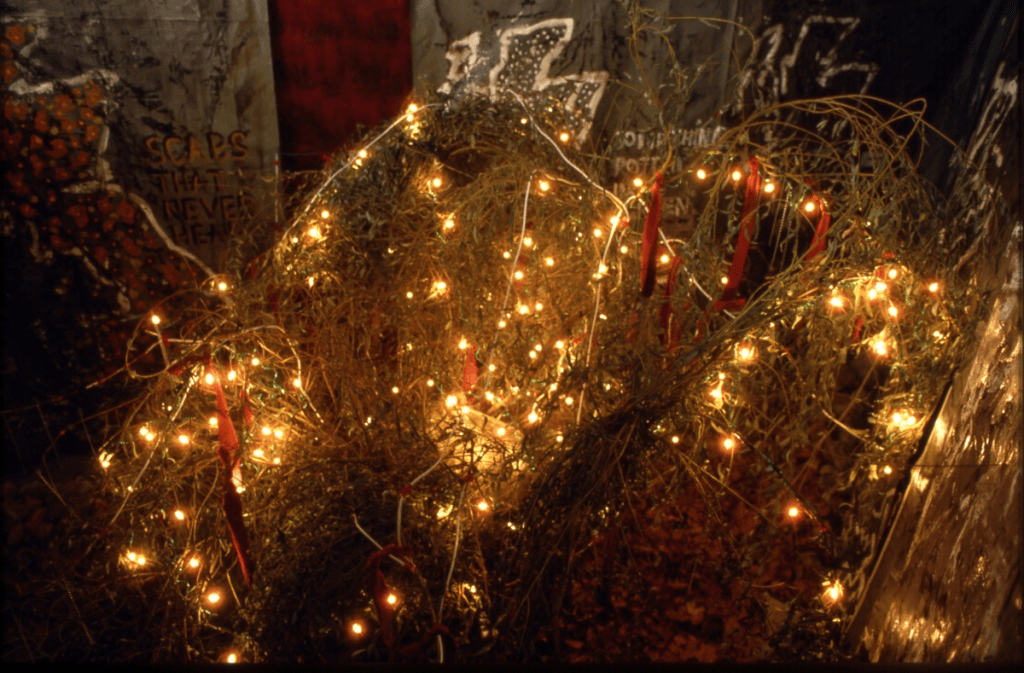
stumble 1
The morning sun had cast long shadows over the city streets as we, the Nomadic Detective Agency embarked on our newest investigation. Today, we delved into the enigmatic concept of a “Body without Organs” and its potential application in shaping the university of the future. Armed with our detective skills, curiosity, and an insatiable appetite for solving mysteries, we set had out to unravel the secrets hidden within the folds of academia.
We started by reading, A Thousand Plateaus, the second volume of Capitalism and Schizophrenia and joint work by Gilles Deleuze and Felix Guattari first published in 1980. We headed towards Plateau ‘6. November 28, 1947: How Do You Make Yourself a Body without Organs?’ It seemed a reasonable place to start our investigation. We were joined by a number of guides who we thought would help us navigate what at first sight seemed complex concepts. Our guides included, Brian Massumi (1992), Awad Ibrahim (2015), Kylie Message (2010), Ian Buchanan (2015), Finn Janning (2021)… Many more clamoured to join in our quest and we know some might not be heard, but we endeavoured to listen to the underrecognised.
We were taken by Finn Janning’s thought that, ‘… to make a BwO is not only to be open to changes but also to facilitate those changes, to manifest Nietzsche’s “will to power” as a “will to create” (Deleuze 2002). The BwO is “a leap forward,” as Braidotti says, “toward a creative reinvention of life conditions, affectivity, and figurations for the new kind of subjects we have already become” (2011, 53) (Janning, 2021:67).
We aspired to be ‘rhizomatic thinkers’ as we saw ourselves as interconnected, non-hierarchical, and averse to the rigidity of traditional structures. We thought of ourselves as a post-human organisation / organism. To help us find a Body without Organs (BwO) we tried to function as one (Deleuze & Guattari, 2015:149-166). Our modus operandi was steeped in the intriguing narrative of a crime fiction tale. An unlikely pairing, perhaps, but one that served the agency-assemblage’s cause in more ways than one. We hummed, as we often do, passages from A Thousand Plateaus in order to understand our own existence and to keep us from falling into the traps that hierarchies often encouraged. We took our queue by thinking, ‘It is not a question of experiencing desire as an internal lack, nor of delaying pleasure in order to produce a kind of externalizable surplus value, but instead of constituting an intensive body without organs,…’ (Deleuze & Guattari, 2015:157).
We started to understand that the ‘crime’ we were investigating was how our hierarchical organisations operate against becoming ‘a body without organs’. As Torkild Thanem (2004) asks in his paper, The body without organs: Nonorganizational desire in organizational life,
In an attempt to challenge the status of the organizational, this paper proposes a ‘nonorganizational’ turn towards embodiment and desire. Introducing and critically discussing Deleuze and Guattari’s (198826. Deleuze Gilles Guattari Felix (1988) A thousand plateaus: Capitalism and schizophrenia, vol. 2 (trans. Brian Massumi), London: Athlone View all references) notion of the ‘body without organs’ (BwO), it argues that this may improve organization theory’s opportunities to think about the forces of embodied desire that disrupt, undermine and escape organization, upset the homogeneity of organizational life, and overpower organizations to such an extent that they cease to be organizations. Rather than adding more ‘organization’ to ‘organizational life’, this may be a way to put more ‘life’ into it. And rather than deeming organization more powerful, this may be a way to recognize its limitations and fragility (Thanem, 2004:1).
As detectives we realised that we needed to locate the metaphorical burial ground of this idea, where it lay dormant or perhaps concealed. We pondered the possibility of a ‘body without organs,’ being a concealed entity requiring a more forensic approach to uncover its true nature.
+
 Nomadic Detective Agency